








The study "A Review of Greek Emigrants – Talent Abroad", prepared by the Organisation for Economic Co-operation and Development (OECD) in collaboration with the National Documentation Centre (EKT), presents the contemporary trends shaping the Greek diaspora and the international mobility of the country's human capital.
The study provides a comprehensive overview of the Greek diaspora across OECD countries, mapping migration trends over recent decades and highlighting the demographic, educational and professional characteristics of Greeks living and working abroad.
Its findings were presented on 3 July 2026 at an event jointly organised by the General Secretariat for Coordination of the Presidency of the Government and EKT, with the participation of OECD representatives. Drawing on data from international and national organisations, the study brings together information that had previously remained fragmented, creating a coherent evidence base on the Greek diaspora and the international mobility of Greeks.
According to the findings, the Greek diaspora across OECD countries remains extensive, with a large share of individuals possessing medium or high levels of education and advanced skills. In recent years, newer migration flows have increasingly shifted towards Northern and Western Europe, while the return of Greek nationals to Greece has gradually strengthened since 2021.
To facilitate the dissemination and use of these findings in Greece, EKT has published the Greek-language edition "The Greek Diaspora in OECD Countries – Key Findings from the OECD's "Talent Abroad" Series for Greece" and launched the dedicated website diaspora.ekt.gr. The publication presents the study's main conclusions in Greek in an accessible and user-friendly format, while the website provides easy access to the data through visualisations and thematic sections.
Key Findings
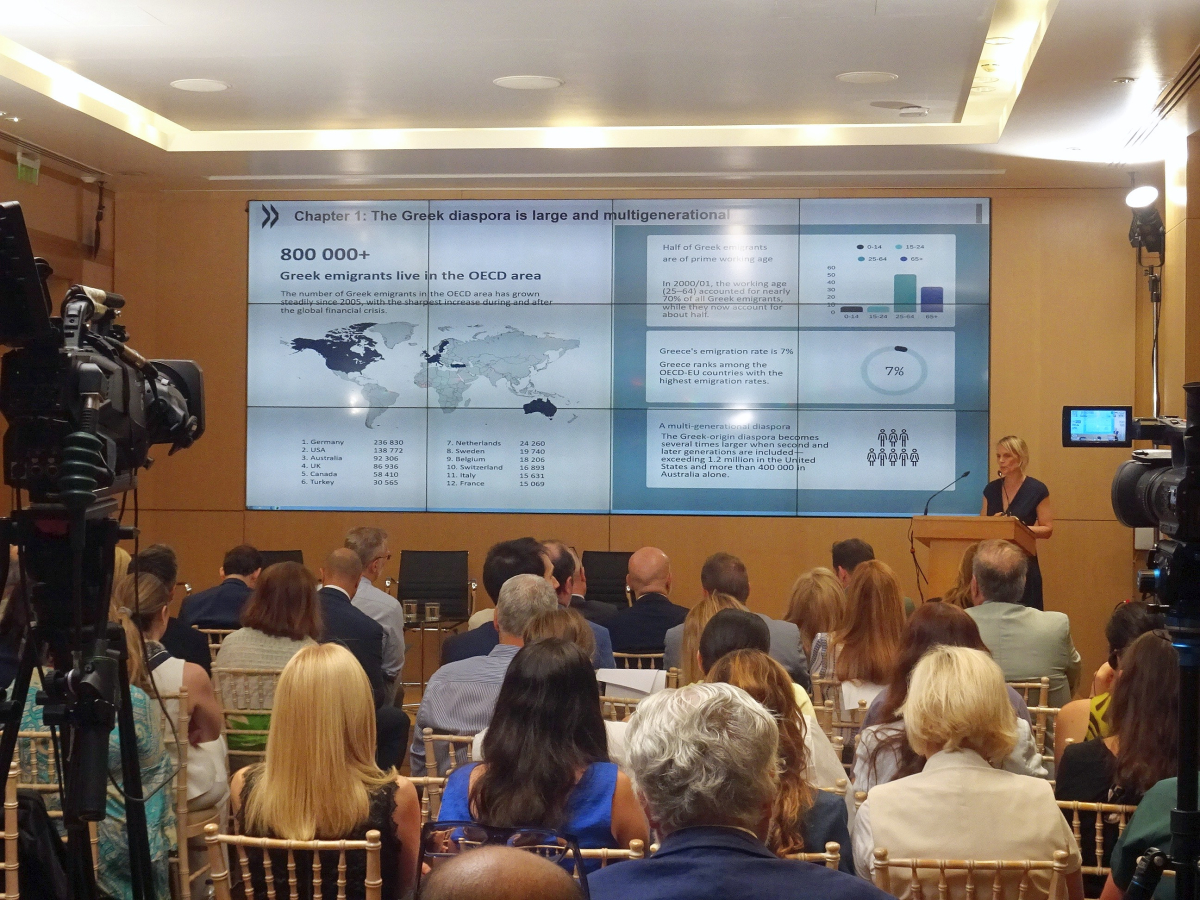
The analysis highlights the enduring importance of Greek migration while demonstrating the gradual transformation of its characteristics in recent years. In 2020/21, more than 800,000 people born in Greece were living in OECD countries. The Greek diaspora also remains highly geographically concentrated, with 93% of Greek-born residents in OECD countries living in just twelve destination countries. Germany, the United States, Australia, the United Kingdom and Canada continue to be the main destinations.
At the same time, the past decade has seen a gradual shift towards more intra-European mobility patterns. Countries in Northern and Western Europe have become increasingly important destinations, particularly for young people, highly skilled workers, students and professionals seeking improved employment opportunities and career prospects.
Particularly significant is the recent increase in the number of Greek nationals returning to Greece. Since 2021, return migration has steadily increased, while 2023 marked the first year since the economic crisis in which the number of returning Greek nationals exceeded the number of those leaving the country. During the period 2023–2024, approximately 98,000 Greek nationals returned to Greece, compared with around 69,000 departures. This fact suggests a gradual rebalancing of the country's migration balance, with recent returnees generally being younger and better educated than the overall population.
Capitalising on this momentum to encourage the return of young and highly skilled Greeks requires targeted policies that facilitate labour market reintegration, reduce administrative and barriers for entrepreneurship, and create attractive conditions for living and professional development in Greece. Such policies should be tailored to different countries of residence, age groups, professional profiles, degrees of connection with Greece, and the specific needs of each target group.
In this context, the key challenge extends beyond encouraging permanent return. It involves transitioning towards a comprehensive model for managing international mobility, reconnecting with the diaspora and harnessing skills. Success should therefore not be measured solely by the number of permanent returnees, but also by Greece's ability to promote brain circulation through research collaborations, mentoring, participation in research projects, investment and business partnerships, access to new markets, knowledge transfer, and stronger links between the diaspora and Greek universities, research centres, businesses and public institutions.
The steady increase in return migration, the high educational profile of many returnees and the strong ties maintained with Greeks abroad create significant opportunities for the country. At the same time, they highlight the need for a permanent intergovernmental mechanism to strengthen engagement with the Greek diaspora and support return migration.
Thematic Sections of the Study
The OECD study, carried out in collaboration with the National Documentation Centre (EKT), draws on a combination of international and national data sources, including the OECD, the United Nations, Eurostat and the Hellenic Statistical Authority (ELSTAT). It is structured around six thematic sections:
- Migration Trends and Geographic Distribution: Examines the size, geographical distribution and long-term evolution of the Greek diaspora across OECD countries. It also analyses recent migration trends and Greeks' intentions to emigrate.
- Demographic and Social Characteristics: Explores the demographic and socio-economic characteristics of Greek migrants and their families, including gender, age and educational attainment. The analysis highlights the composition and evolution of the diaspora's human capital.
- Labour Market Integration and Skills: Assesses the participation of Greek migrants in labour markets by examining employment, unemployment and occupational distribution. It also analyses their skills, the incidence of overqualification and entrepreneurial activity.
- Return to Greece – Trends, Drivers and Policies: Examines patterns of return migration and the factors influencing them. It also reviews policies and good practices that can strengthen the attraction, return and reintegration of members of the Greek diaspora.
- International Mobility, Educational Attainment and Research Activity: Analyses the international mobility of Greek students and researchers, along with their demographic and professional profiles. It also examines the duration of their stay abroad and their prospects for returning to Greece.
- Human Capital Utilisation Strategies: Reviews existing policies and proposed interventions aimed at strengthening engagement with the Greek diaspora and making better use of its human capital.
Event: Greek Talent Abroad: The Return
The findings of the OECD–EKT study were presented to the Greek public for the first time on Friday, 3 July 2026, at an event organised by the General Secretariat for Coordination of the Presidency of the Government and EKT, in the presence of members of the political leadership.
The event was opened by Evi Dramalioti, Secretary General for Coordination of the Presidency of the Government in Greece. Institutional remarks followed by Akis Skertsos, Minister of State; Niki Kerameus, Minister of Labour and Social Security; and Giannis Loverdos, Deputy Minister of Foreign Affairs.

The study's key findings were presented by Jean-Christophe Dumont, Head of the OECD International Migration Division, and Lisa Andersson, Policy Analyst at the OECD Directorate for Employment, Labour and Social Affairs. Their presentations provided valuable insights into the contemporary challenges and opportunities associated with talent mobility and its contribution to the growth and competitiveness of the Greek economy.
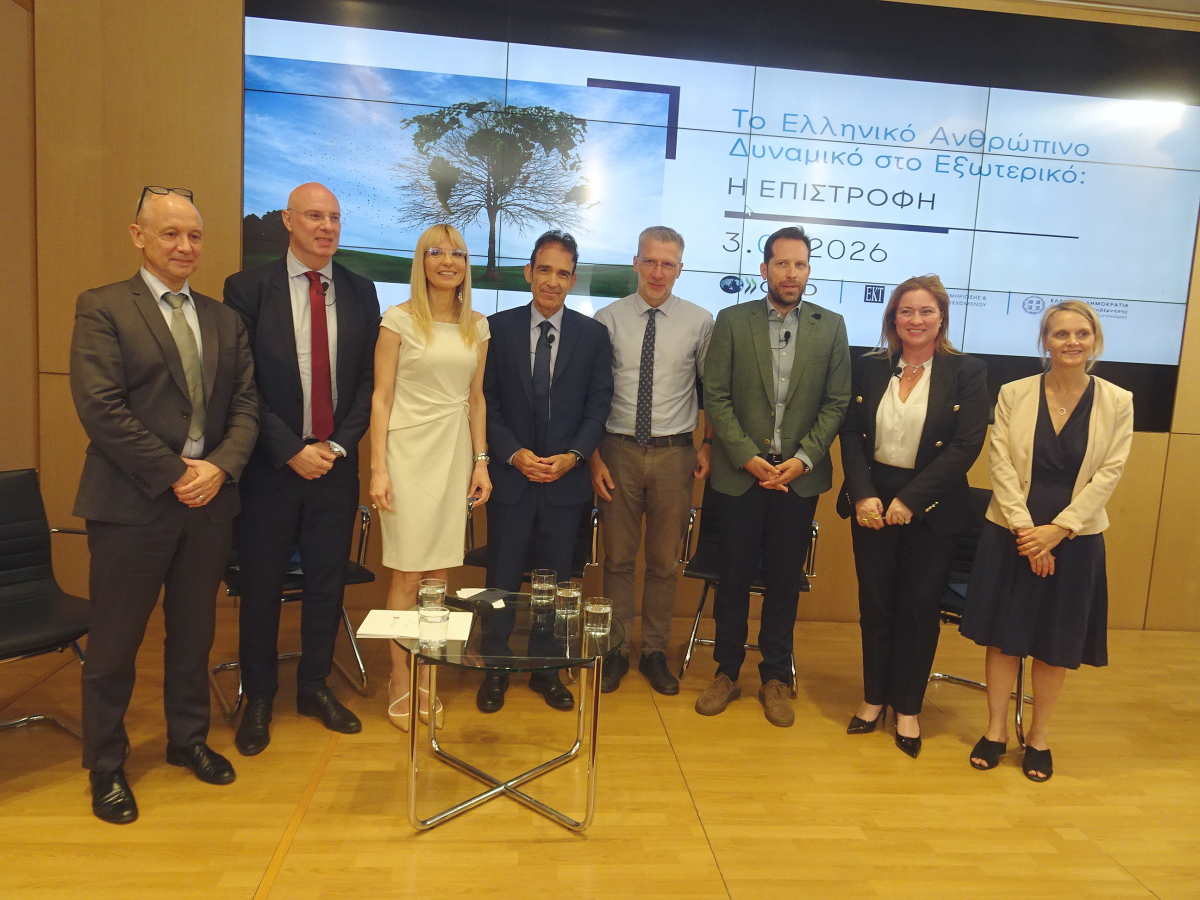
The event concluded with an open panel discussion moderated by Kyriakos Tolias, Director of the National Documentation Centre (EKT). The discussion featured George Pagoulatos, Ambassador and Permanent Representative of Greece to the OECD; Maira Myrogianni, Secretary General for Greeks Abroad and Public Diplomacy; Evi Dramalioti, Secretary General for Coordination of the Presidency of the Government; and Nikos Milapidis, Secretary General for Labour Relations at the Ministry of Labour and Social Security.

A key conclusion of the discussion was that the reversal of Greece's migration trend is now both visible and measurable, as it is increasingly reflected in OECD data. This development is not the result of chance, but rather of converging efforts across employment, research, diaspora engagement and public policy. However, sustaining this positive momentum will require continued coordination, robust evidence and measurement, and consistent policy implementation.
The Greek Edition and EKT's Dedicated Online Platform
EKT's Greek-language publication, The Greek Diaspora in OECD Countries – Key Findings from the OECD's "Talent Abroad" Series for Greece, presents a concise overview of the main findings of the EKT–OECD collaboration, offering an evidence-based, up-to-date and multidimensional perspective on the Greek diaspora across OECD countries.
Drawing on reliable data, the publication highlights the key dimensions of contemporary Greek mobility, including the size and geographical distribution of Greek migrants, recent migration trends, their position in the labour markets of destination countries, return migration patterns, and the international presence of Greek students, researchers and scientists. It also identifies the conditions needed to strengthen Greece's engagement with Greeks abroad and to support the development of policies that effectively harness the human capital of the Greek diaspora.
In conjunction with the publication, EKT launched the dedicated online platform diaspora.ekt.gr, which brings together data visualisations, videos and related resources, facilitating access to, understanding and use of key information on the Greek diaspora. Through thematic sections and interactive visualisations, the platform presents accessible data on the geographical distribution, characteristics, migration flows, return migration and international mobility of Greeks.
For EKT, this initiative forms part of its institutional mission as Greece's national organisation for the production, documentation, analysis and dissemination of reliable data and knowledge. It helps address a longstanding gap in the collection and analysis of data on Greek migration while supporting the design of evidence-based public policies that strengthen Greece's engagement with Greeks abroad.
Μάθετε Περισσότερα
Σχετικά Νέα
-
 10.07.2026
 -
 29.10.2024
 -
 04.12.2019
 -
 14.02.2019
 -
 04.09.2018
 -
 25.01.2018
 -
 25.10.2017
 -
 19.10.2017