







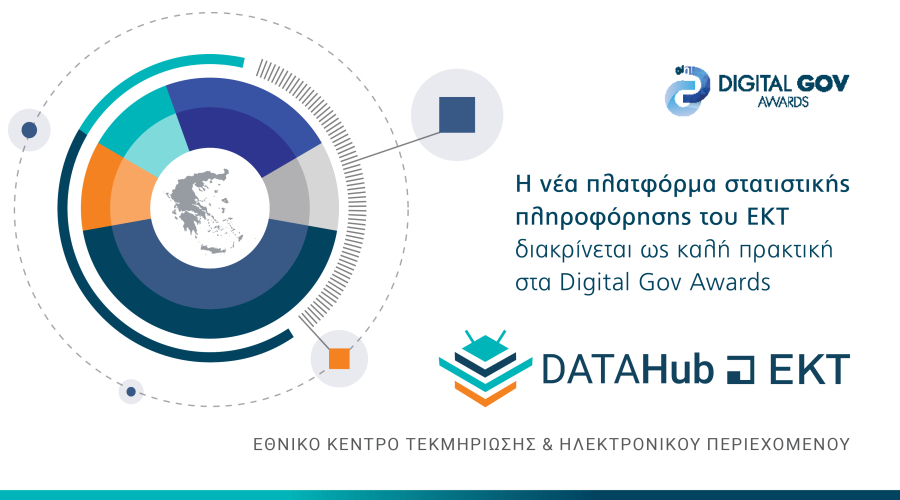
The DATAHub@EKT platform, an innovative tool that facilitates access to, understanding, and use of statistical data from the National Documentation and Electronic Content Center (EKT), was recognized at the Digital Governance Awards 2024, receiving first prize in the category “Best Applied Idea – In-house” for digital transformation initiatives by the Ministry of Digital Governance and its supervised bodies.
The platform (https://datahub.ekt.gr) provides interactive access to statistical data on Research, Innovation, and Digital Transformation, offering a technologically mature and comprehensive solution for the management, analysis, and dissemination of public data. In this way, it highlights EKT’s leading role in data governance and the digital transformation of the public sector.
“EKT plays a pivotal role in the public policy cycle, supporting decision-making through evidence-based data, while actively contributing to the development of new policy proposals grounded in modern digital tools, enhancing transparency and sustainability in public interventions. With DATAHub@EKT, we leverage digital technologies to organize and provide data to the research community, the public sector, and citizens,” stated EKT Director Dr. Kyriakos Toliás.
The Digital Governance Awards (https://digitalawards.gov.gr), organized by the General Secretariat for Information Systems and Digital Governance of the Ministry of Digital Governance, recognize and reward innovative practices by public bodies and officials that enhance efficiency, transparency, and citizen services. The 2024 awards ceremony will take place at a special event in the near future.
Discover EKT’s new statistical data platform
As a National Authority and member of the Hellenic Statistical System, EKT produces a significant volume of statistical data and indicators, operating as a mechanism for official statistical information and the evaluation of public policies.
Leveraging its expertise and infrastructure, the organization develops and maintains a modern statistical environment based on advanced technologies and strong methodological documentation—an approach also recognized in the Eurostat Peer Review Report on the Greek Statistical System.
DATAHub@EKT was created to strengthen EKT’s public statistical information mechanism and enhance the services it provides to public and private sector stakeholders. Its goal is to function as a central, user-friendly, and interactive reference point for statistical data on Research, Technology, Development, Innovation (RTDI), and Digital Transformation in Greece.
Specifically, DATAHub@EKT is based on European and national statistics produced by EKT and includes the following thematic areas:
European Statistics: Business Innovation, Research and Development, Government Budget Allocations for R&D National Statistics: Digital Transformation, Regional Indicators, Scientific Publications, Doctorate Holders, Women in R&D, Research Activity
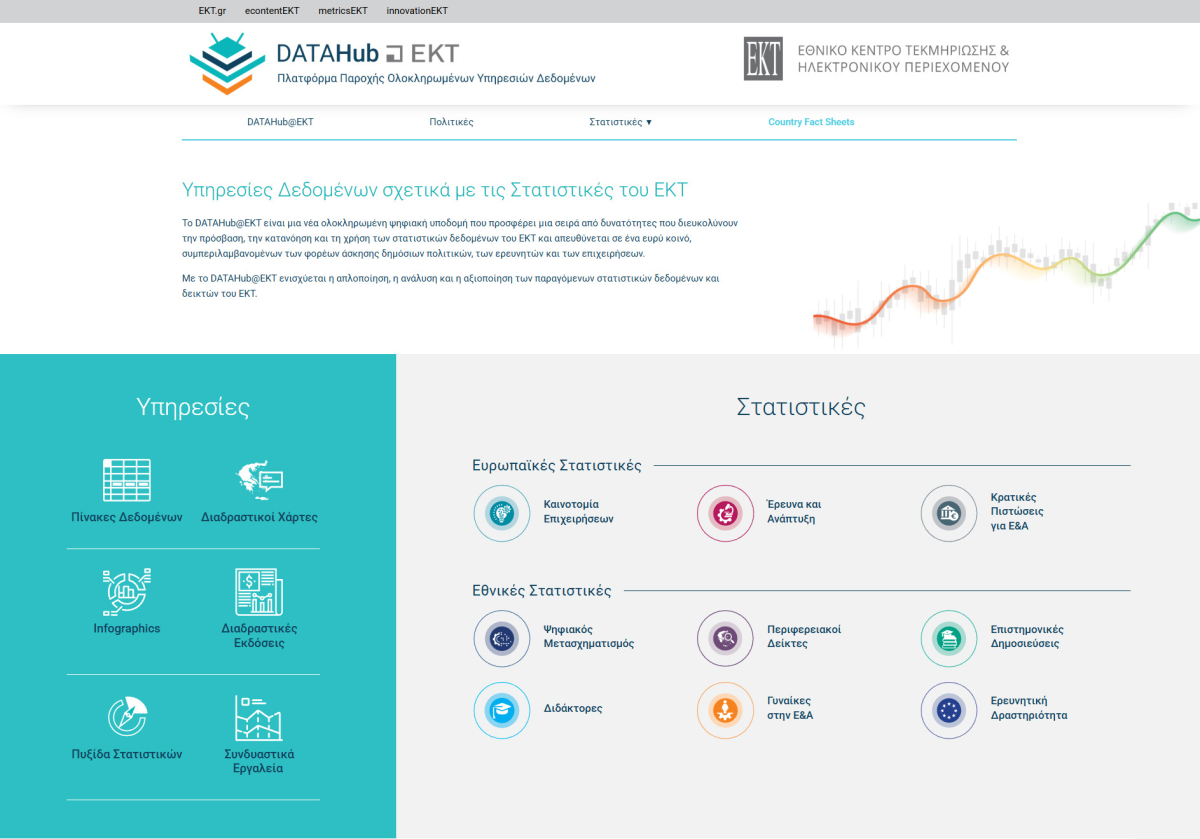
Alongside EKT’s existing statistical presentation infrastructure (metrics.ekt.gr), the platform offers features such as:
- unified access to all RTDI and digital economy statistical data produced by EKT
- data visualization through interactive charts, maps, and infographics
- advanced search and filtering by multiple criteria (data type, time period, geographic area, etc.)
- combined display and comparison of indicators from different datasets
- monitoring of trends over time
- download of 155 datasets in open format (.xlsx) for further analysis
By aggregating, visualizing, and interactively presenting data, the platform supports evidence-based decision-making, evaluation of research and innovation activity, and transparency and accountability in science and technology sectors. It also enables comparative analysis with international data, offering a comprehensive view of Greece’s position within the European and global landscape in RTDI and the digital economy.
Who is DATAHub@EKT for?
The platform is designed for a wide range of users, addressing the needs of public administration, the scientific community, businesses, and civil society.
- Public sector bodies (ministries, regional authorities) can use the data for policy design, evaluation, and monitoring—especially in research, innovation, and digital governance.
- Universities and research centers gain a reliable tool to support research activities, with access to relevant statistics and indicators.
- Businesses (SMEs and large enterprises) can identify trends, design strategies, and support investment decisions using the platform’s data and visualizations.
- The general public, journalists, and civil society gain access to open data, charts, and maps that enhance transparency and facilitate understanding of complex social and policy issues.